Autumn events

I have a few events coming up over the next few weeks, if anyone is interested in attending a poetry reading or a writing workshop.

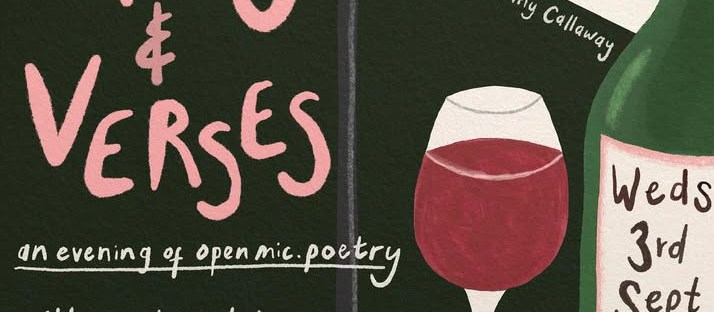
First of all, I’m reading from The Opposite of Swedish Death Cleaning at the new poetry night hosted by Bethany Callaway at Chater’s in Saffron Walden on Wednesday 3rd September. Beth only launched this monthly event in July, but the first two months were sold out, so grab a ticket quickly if you’re interested in coming along in September. I really admire Beth’s tenacity and flair for getting this going so successfully in such a short space of time. There are open mic slots available, and I’ll be doing a 20 minute set before the interval.

On Monday 22nd September from 5pm I’ll be running an online poetry writing workshop on Zoom for the Mslexia Salon called All Over the Place, in which we’ll be exploring a range of ways to generate new poems from fresh encounters with familiar and unfamiliar places.

I’ll be reading at Cambridge’s regular poetry night in the Town and Gown, CB1 Poetry, on Sunday 5th October from 6.30pm.

And finally, I’m headlining the lovely Fen Speak at Centre E Community Hub in Ely on Thursday 16th October from 7.30pm, with two poetry sets alongside a range of wonderful open-miccers.

Do get in touch via my contact form if you’d be interested in booking me for a poetry reading or writing workshop from November onwards.

CURATING THE LINE: the impact on trainee English teachers of belonging to a peer-run writing group

How can you teach creative writing unless you’re a practising writer yourself? That sounds like a perfectly reasonable question to ask. But whilst most secondary school English teachers could probably tell you what book they’re currently reading for pleasure without a second’s hesitation, ask what they’re writing and in most cases the reaction will likely be very different.

There are lots of reasons for that, not least the huge weight of work that goes with the territory of being a classroom teacher – and especially a teacher of English. There’s also the fact that good English teaching is highly creative work – work that harnesses and then saps the very creative energy that in other circumstances teachers might be investing in their own writing.

And then there’s the insecurity about writing that, sadly, is sometimes instilled in English teachers through painfully memorable confidence-zapping encounters in their own education. And perhaps the inevitable feeling of humility about one’s own writing that comes with spending so much time exploring the brilliant writing of others.

The PGCE English course at the University of Cambridge places a high value on encouraging student teachers to practise their own writing, and, as they do so, to reflect on how this shapes their practice in the classroom. For many, and sometimes even for those who arrive at the course having done Creative Writing degrees, that’s a liberating, refreshing and surprisingly enjoyable experience. Our hope is to produce English teachers who will see themselves as teacher-writers, or writer-teachers, and that this will in turn enrich the writing of the students they work with in schools.

One recent cohort of trainee English teachers so valued the experience of writing together that they established their own peer-run writing group, which met several times throughout the PGCE year, which provided the opportunity for me to carry out some research into the impact on these student teachers of belonging to this group. This has just been published in an article in English in Education, the research journal for the National Association for the Teaching of English, which can be accessed here.

It was heartening to find that all of the participants in this research could articulate how belonging to a peer-run writing group had impacted their teaching of creative writing. But perhaps the most interesting and unexpected finding was about vulnerability. Several of the participants spoke movingly about times when their writing group had offered them a supportive space in which to share something of themselves than they might otherwise not have done, in a way that felt manageable. One described this as being an opportunity to ‘curate the line’ in terms of working out how to make themselves vulnerable to one another during a highly formative and demanding year. Curiously, they then discovered that having practised doing this in the writing group, they felt more skilful and confident in developing their own teaching personae in the potentially exposing setting of the classroom.

A follow-up study would be needed to explore the role played by writing in the lives of these beginning teachers a couple of years into their careers. But the discovery that writing together alongside other beginning teachers not only developed their confidence as writers but also as professional practitioners seemed to have a significant impact on these trainee teachers’ sense of autonomy and expertise.

Fathers, witches and things that fall out of books: The Verb, with Ian McMillan

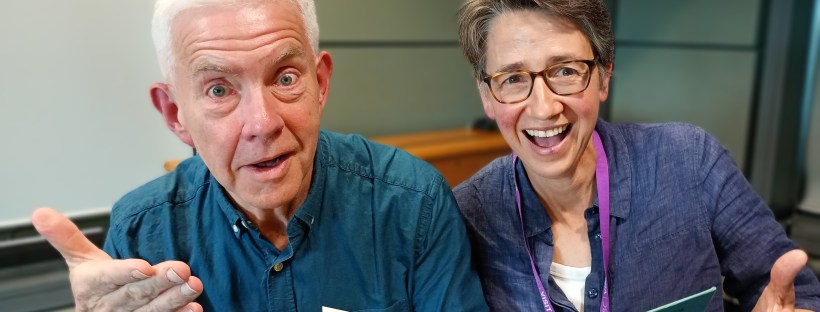
It was a dream come true to have the opportunity to read and talk about three poems from The Opposite of Swedish Death Cleaning on BBC Radio 4’s The Verb, hosted by Ian McMillan, and alongside guests Fiona Benson, Boo Hewerdine and Yvonne Lyon.

The show is available on BBC Sounds, and also as a podcast.

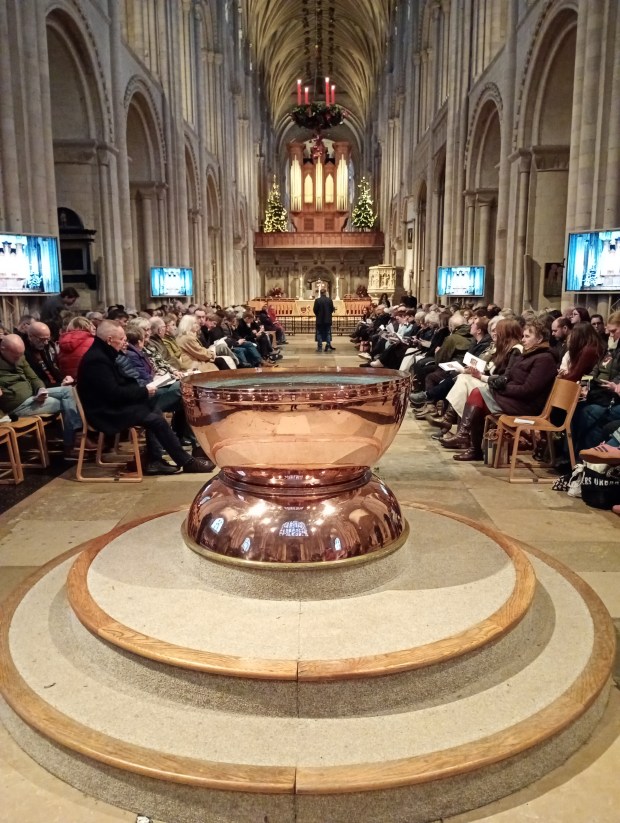
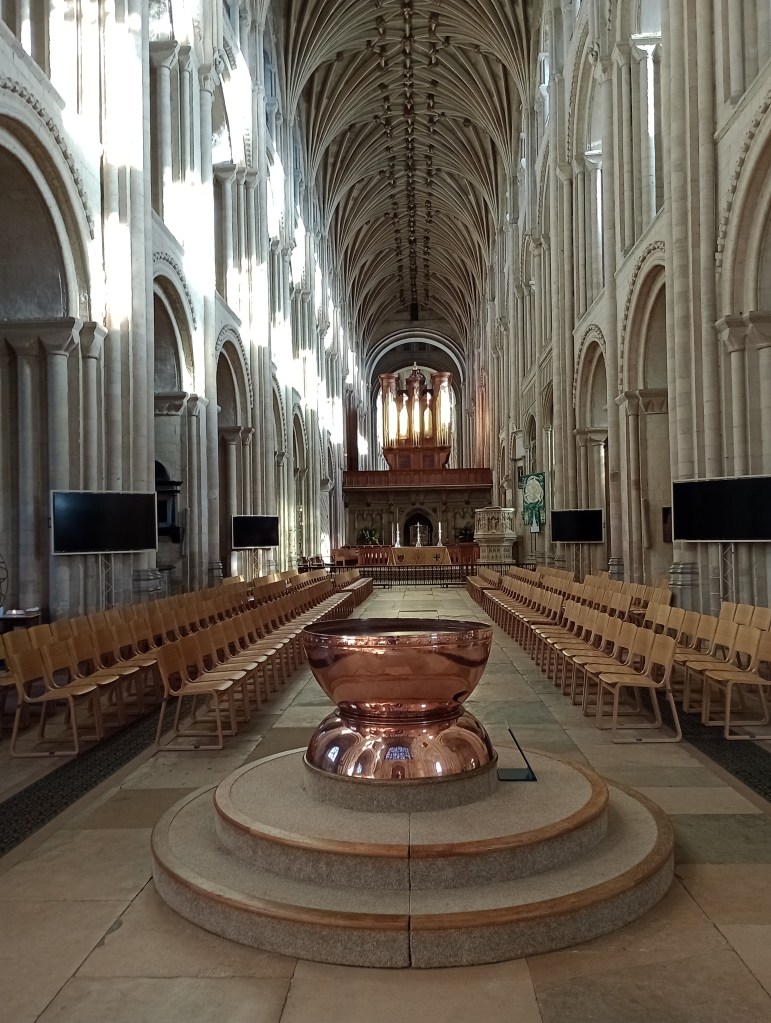
Although the focus of my segment was on writing about a parent with dementia – something that felt particularly poignant given that the programme was aired on Fathers’ Day – I was really glad that Ian had selected Muscle Memory for me to read and discuss, as it’s a reminder of the moments of joy that can still be found even amidst so much loss. Here’s a photo of the beautiful copper font in Norwich Cathedral ‘that stretched our faces like toffee’ – an allusion to the fact that it was donated when the Rowntree’s chocolate factory closed down, having previously been used to melt toffee.

I love Fiona Benson’s collection Midden Witch, so it was brilliant to hear her talking about the stories behind some of these poems, like The Witch of Easington and Jenny Greenteeth. Some of my favourite poems in this collection are those inspired by birds and animals, and it’s fascinating to see how placing them in a section entitled ‘Familiars’ curiously shifts the reader’s perspective on creatures such as bowerbirds and snails.

Boo Hewerdine and Yvonne Lyon’s songs about things that fall out of books tied the whole show together, and it was spine-tingling to hear their music up close in the studio. I was so touched that Boo set a line from Inside the House of Delirium to music: ‘The curtains sleep until midday’.

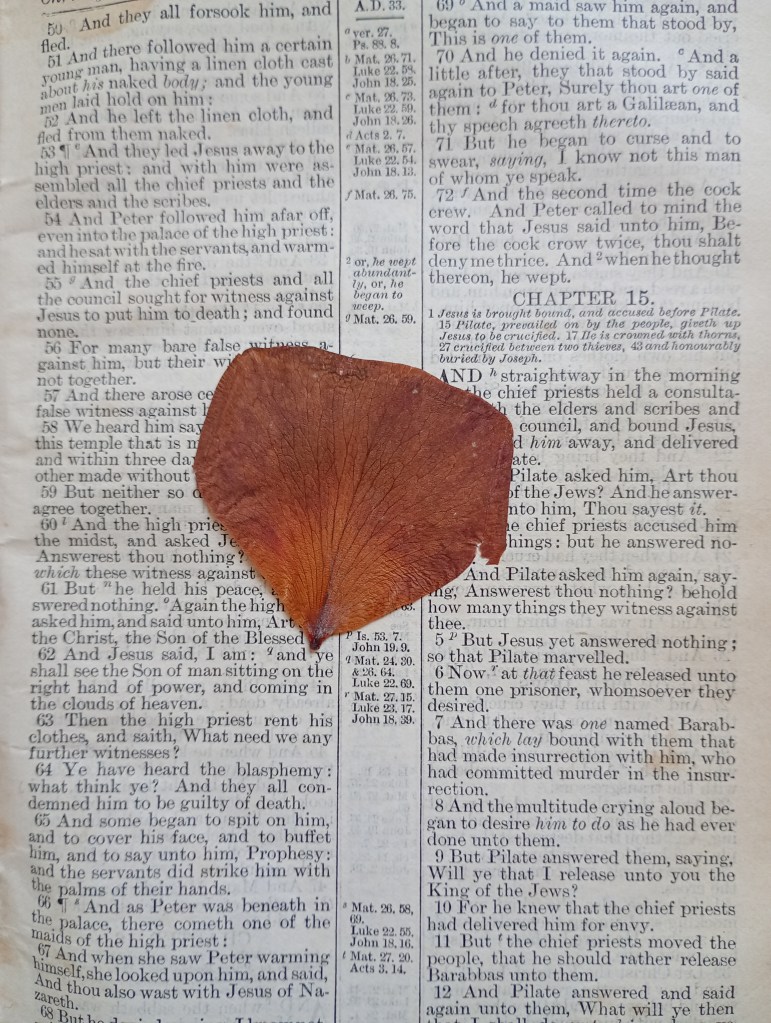
If we’d had more time, I would have shared this poppy petal that fell out of my great grandmother’s Bible, which she used as a flower press. It’s incredible to think that it must have been flowering in a Cornish hedgerow in the 1880s.

Launch events for ‘The Opposite of Swedish Death Cleaning’

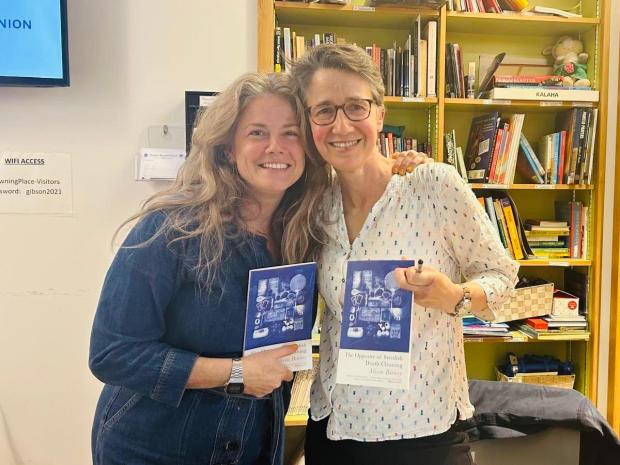
It was lovely to celebrate the publication of ‘The Opposite of Swedish Death Cleaning’ on Friday 16th May at Downing Place United Reformed Church. There were people there from various different parts of my life: teaching friends, rowing friends, church members, friends I was at school with, members of the U3A contemporary poetry group I’ve led sessions with, and walking friends, as well as members of my family.

It was a particular honour to have Kate Winter there, the artist who designed the stunning cover for both this poetry collection and my pamphlet, ‘Other Women’s Kitchens’.

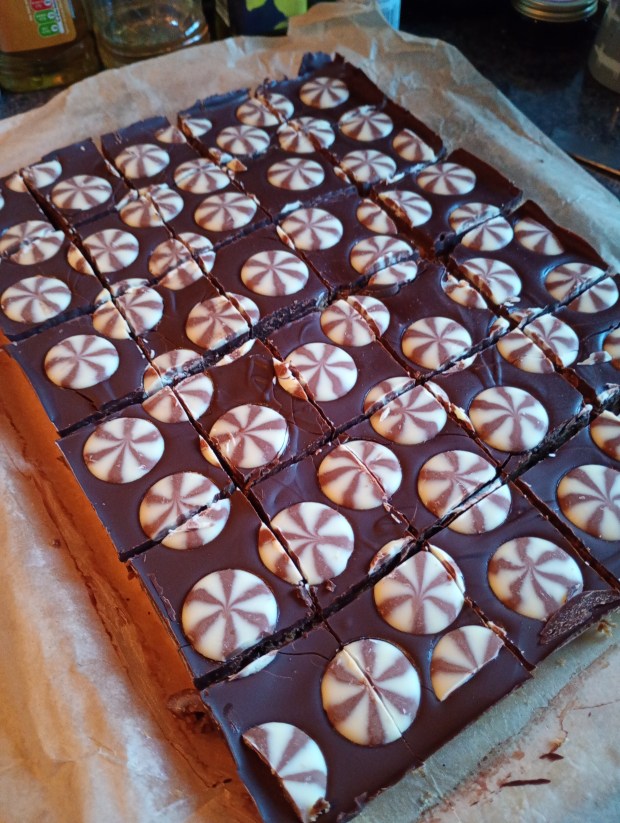
The launch was accompanied by a huge batch of chocolate fridge cake, made by my partner Emily to my grandmother’s recipe, which is handwritten in the recipe book that appears in the top left hand corner of the cover.

I have a series of other launch events lined up over the next few months, and would be delighted to see people there. Here are the details:

7.00pm Thursday 29th May: Wave of Nostalgia, Haworth

7.30pm Thursday 19th June: Between the Lines, Great Bardfield

4.00pm Tuesday 1st July: Faculty of Education, University of Cambridge

6.30pm Sunday 5th October: CB1 Poetry, Town & Gown, Cambridge

7.30pm Thursday 16th October: Fen Speak, Centre E Community Hub, Ely

I’m also very open to invitations to read at other events, so do drop me a line via the ‘Contact’ section on this website if you would like to make a booking.

Cut-out poetry – reclaiming analogue teaching

Sometimes you read an article or blog post by another teacher and think, ‘Yes! Thank goodness somebody else thinks that too!’ That was the case this week when I read a post by Emma Turner called ‘Powerpoint and IWBs – It’s time to reclaim analogue teaching’.

Turner, a highly experienced teacher, school leader and education consultant, makes a passionate and well-argued case for a return to ‘the beauty and effectiveness of analogue teaching’, in an era when the default seems to be for students to spend large chunks of lesson time passively watching pre-prepared slides on a giant screen, which has, she argues, ‘assumed a shrine-like status in our classrooms’. It’s well worth reading the whole post, but my favourite paragraph is this one:

Teaching is about responding to the emerging thinking in front of us. It is not about producing neat, sanitised sequences for passive recipients to be presented with. Teaching is alive, it is interrogative, it is dynamic; it is fizzing with variables and influences, so the very idea that a route through a challenging concept with 30 individuals all with unique schema and experience can be predicted and planned for with any degree of invariability is bordering on farcical.

Turner’s case for ‘analogue teaching’ is applicable to all subjects and all ages, but as an English teacher that phrase ‘fizzing with variables and influences’ particularly resonates with me.

It’s been lovely to see the response to Emma Turner’s blog post, with other teachers chipping in with their lists of tried and tested classroom ideas which don’t involve screens and slides, and which, instead, call for pipe-cleaners, plasticine, shoe-boxes, crayons, sugar paper, props, costumes, sock puppets, old rolls of wallpaper and so on. Or which, in English lessons, simply involve reading aloud, without recourse to pre-prepared notes on slides, and then getting students to write creatively in response.

One of the lessons I most enjoyed teaching last term came at the end of a Year 8 unit on poetry. It was the last week before Easter and I’d taught all the poems in the scheme of work, plus a couple of extras. I was looking for something to sum up our sense of the range of poems we’d been exploring together, and also to leave my students with a memory of poetry as being something playful, and, above all, something that they could access and enjoy with confidence.

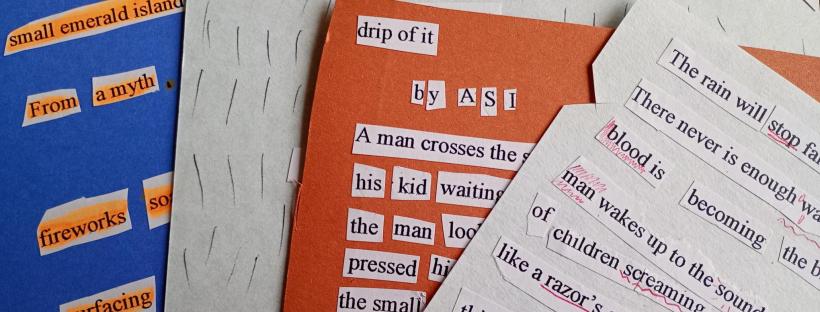
Like many of the best lessons, this one was easy to set up, and involved very little input from me during the lesson itself. All I did was to copy and paste four of the poems we’d studied, without their line breaks, into a Word document, leaving 1.5 spacing between the lines. I printed one sheet for each student in the class. And then I gathered all the scrap paper and cardboard I could find: the lids of old boxes lying around in the English office; the sheets of cardboard that often come in packs of A4 lined paper; flaps of old document folders that had been used many times; scraps of sugar paper; offcuts of coloured card.I brought all of this to the lesson, together with as many glue sticks and pairs of scissors as I could find. The lesson wasn’t entirely Powerpoint-free: I had one slide with an example of a cut-out poem on, just to give students an idea of what sort of thing they would be creating.

That was it. For a whole hour, on a Wednesday afternoon, my students were busily, happily and, best of all, creatively engaged in selecting, snipping, placing, rearranging, hunting, editing, adapting, illustrating, explaining as they created their own cut-out poems, using words from the poems we had been studying in our previous lessons. It was one of those lessons when, for much of the time, I really needn’t have been in the room at all. That freed me up to circulate and chat to students as they worked, hearing about the creative challenges they were encountering and how they were solving them. For example, what to do if you really needed a particular word and it wasn’t there? One student painstakingly snipped out every letter to spell the word he needed. Another did the same, and then realised that this meant she could be playful about the spacing between the letters, deliberately stretching the word out. She was able to articulate with great confidence why she had decided to do this and what impact she intended it to have on the reader.

At a time when there is so much concern about the amount of time young people are spending online, it was so heartening to see how satisfying these Year 8 students found the physicality of cutting, arranging and sticking, and how proud they were of what they produced.

In a lesson like this it’s amazing to see how everyone starts with exactly the same text – the words from four of the poems that we’d studied – but by the end of the lesson no two poems are alike. Cut-out poetry is an approach that supports those who lack confidence in writing: no one need worry about staring at a blank page, because the starting-point is always a page full of words. But it allows for huge flexibility in response. To return to that quotation from Emma Turner’s blog, it’s an approach that is ‘alive, it is interrogative, it is dynamic; it is fizzing with variables and influences’.

I welcome the sharing of approaches that celebrate what happens in classrooms when students are given the space, resources and inspiration to be active creators, rather than passive recipients.

Hearth at Gladstone’s Library – A Kitchen of one’s own

When I first tried out Other Women’s Kitchens as a title for my debut poetry pamphlet, I was surprised to find how many of the poems in it are set in kitchens, or makeshift kitchens. I continue to draw on kitchens for inspiration in my writing, particularly in some of the recent poems that have arisen from the experience of sorting and clearing my parents’ house.

Some of my favourite poems by other poets are set in or around kitchens. I think of Seamus Heaney’s sonnet about peeling potatoes with his mother, for example, Mary Jean Chan’s They Would Have All That, and Alison Brackenbury’s collection Aunt Margaret’s Pudding, inspired by her grandmother’s recipes.

For me, kitchens, more than anywhere else, are the spaces where important things happen. Eating is both a primal need, and something that can be sophisticated and elaborate, such as cooking for a date or a dinner party. Cooking and eating are ritualistic acts, both in the everyday repetitions of making cups of tea or bowls of porridge, and also in the less frequent but perhaps more highly-charged rituals of Christmas, Thanksgiving, Shabbat, Iftar. Food is nourishment, treat, discipline, spectacle, connection, tradition, symbol, sacrament. And kitchens are places where we gather to eat and to cook intergenerationally, with all of that passing-on, both implicit and explicit, that takes place when we do those things with others.

So it was strange to give a talk entitled ‘A Kitchen of One’s Own’ at Hearth 2024, while staying in the wonderfully congenial environment of Gladstone’s Library, where three delicious meals a day were cooked for me in the Food for Thought cafe. There, not only did I not need to cook – a sign saying ‘Strictly Staff Only’ kept me banned from the kitchen for three days.

As lovely as it is to be cooked for, it’s fascinating what that does to the rhythm of life. Days feel much longer when you don’t need to shop, plan meals, cook or wash up. But it also makes me feel somehow wrong-footed when that rhythm is suddenly removed.

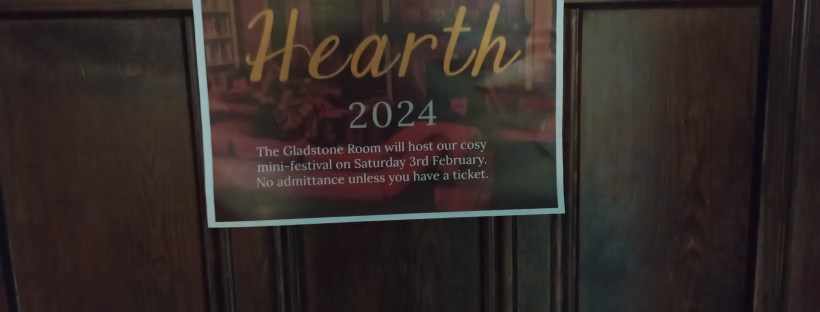
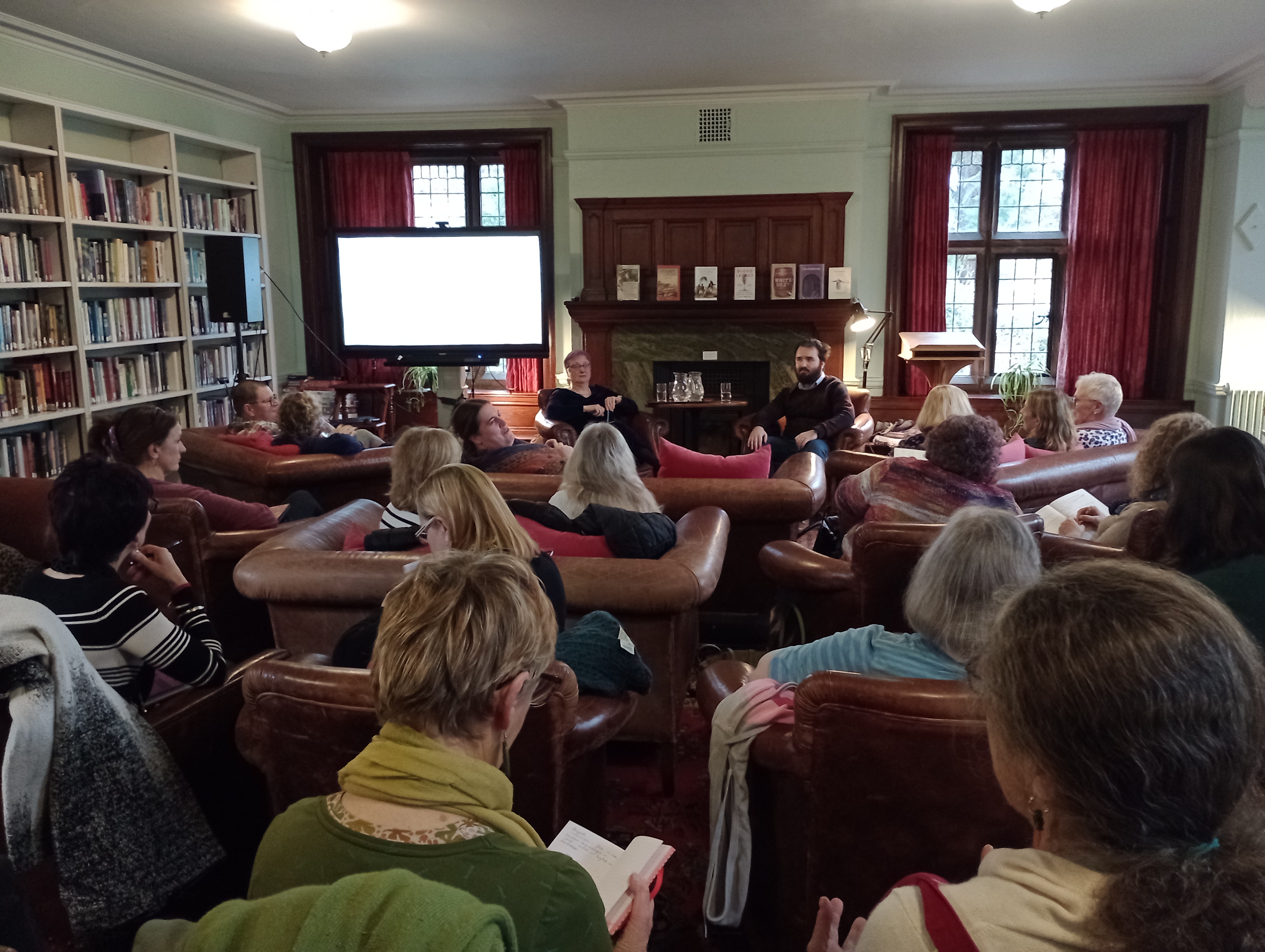
That observation proved a helpful starting-point for my talk at Hearth, the annual mini-festival at Gladstone’s Library, which was a lovely event to speak at, with the talks taking place in the intimate setting of a lounge filled with comfy leather sofas. After my talk, I thoroughly enjoyed listening to the other speakers – Eleanor Wasserberg, Frederick Bricknell and Louise Gray. Although on paper it was hard to anticipate how our four talks might work together, it was fascinating to see common themes emerging and developing throughout the day: the challenge of listening to undocumented voices; the sharing of family history; the dilemmas around sourcing and eating particular foods. The audience – warm, receptive, astute – played a huge part in helping those threads to emerge, and in enabling the conversations to continue over lunch and dinner.

I’m so grateful to the team at Gladstone’s Library for the privilege of speaking at Hearth, and for the wonderful hospitality, organisation and welcome. I will definitely be back, and I’m looking forward to it already.