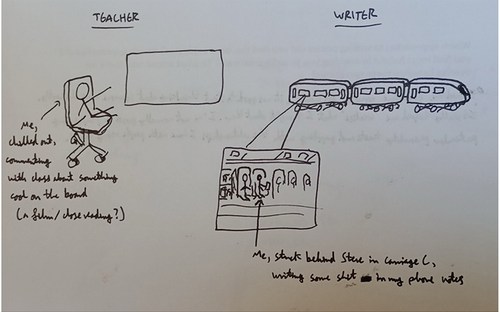
CURATING THE LINE: the impact on trainee English teachers of belonging to a peer-run writing group

How can you teach creative writing unless you’re a practising writer yourself? That sounds like a perfectly reasonable question to ask. But whilst most secondary school English teachers could probably tell you what book they’re currently reading for pleasure without a second’s hesitation, ask what they’re writing and in most cases the reaction will likely be very different.

There are lots of reasons for that, not least the huge weight of work that goes with the territory of being a classroom teacher – and especially a teacher of English. There’s also the fact that good English teaching is highly creative work – work that harnesses and then saps the very creative energy that in other circumstances teachers might be investing in their own writing.

And then there’s the insecurity about writing that, sadly, is sometimes instilled in English teachers through painfully memorable confidence-zapping encounters in their own education. And perhaps the inevitable feeling of humility about one’s own writing that comes with spending so much time exploring the brilliant writing of others.

The PGCE English course at the University of Cambridge places a high value on encouraging student teachers to practise their own writing, and, as they do so, to reflect on how this shapes their practice in the classroom. For many, and sometimes even for those who arrive at the course having done Creative Writing degrees, that’s a liberating, refreshing and surprisingly enjoyable experience. Our hope is to produce English teachers who will see themselves as teacher-writers, or writer-teachers, and that this will in turn enrich the writing of the students they work with in schools.

One recent cohort of trainee English teachers so valued the experience of writing together that they established their own peer-run writing group, which met several times throughout the PGCE year, which provided the opportunity for me to carry out some research into the impact on these student teachers of belonging to this group. This has just been published in an article in English in Education, the research journal for the National Association for the Teaching of English, which can be accessed here.

It was heartening to find that all of the participants in this research could articulate how belonging to a peer-run writing group had impacted their teaching of creative writing. But perhaps the most interesting and unexpected finding was about vulnerability. Several of the participants spoke movingly about times when their writing group had offered them a supportive space in which to share something of themselves than they might otherwise not have done, in a way that felt manageable. One described this as being an opportunity to ‘curate the line’ in terms of working out how to make themselves vulnerable to one another during a highly formative and demanding year. Curiously, they then discovered that having practised doing this in the writing group, they felt more skilful and confident in developing their own teaching personae in the potentially exposing setting of the classroom.

A follow-up study would be needed to explore the role played by writing in the lives of these beginning teachers a couple of years into their careers. But the discovery that writing together alongside other beginning teachers not only developed their confidence as writers but also as professional practitioners seemed to have a significant impact on these trainee teachers’ sense of autonomy and expertise.
Cut-out poetry – reclaiming analogue teaching

Sometimes you read an article or blog post by another teacher and think, ‘Yes! Thank goodness somebody else thinks that too!’ That was the case this week when I read a post by Emma Turner called ‘Powerpoint and IWBs – It’s time to reclaim analogue teaching’.

Turner, a highly experienced teacher, school leader and education consultant, makes a passionate and well-argued case for a return to ‘the beauty and effectiveness of analogue teaching’, in an era when the default seems to be for students to spend large chunks of lesson time passively watching pre-prepared slides on a giant screen, which has, she argues, ‘assumed a shrine-like status in our classrooms’. It’s well worth reading the whole post, but my favourite paragraph is this one:

Teaching is about responding to the emerging thinking in front of us. It is not about producing neat, sanitised sequences for passive recipients to be presented with. Teaching is alive, it is interrogative, it is dynamic; it is fizzing with variables and influences, so the very idea that a route through a challenging concept with 30 individuals all with unique schema and experience can be predicted and planned for with any degree of invariability is bordering on farcical.

Turner’s case for ‘analogue teaching’ is applicable to all subjects and all ages, but as an English teacher that phrase ‘fizzing with variables and influences’ particularly resonates with me.

It’s been lovely to see the response to Emma Turner’s blog post, with other teachers chipping in with their lists of tried and tested classroom ideas which don’t involve screens and slides, and which, instead, call for pipe-cleaners, plasticine, shoe-boxes, crayons, sugar paper, props, costumes, sock puppets, old rolls of wallpaper and so on. Or which, in English lessons, simply involve reading aloud, without recourse to pre-prepared notes on slides, and then getting students to write creatively in response.

One of the lessons I most enjoyed teaching last term came at the end of a Year 8 unit on poetry. It was the last week before Easter and I’d taught all the poems in the scheme of work, plus a couple of extras. I was looking for something to sum up our sense of the range of poems we’d been exploring together, and also to leave my students with a memory of poetry as being something playful, and, above all, something that they could access and enjoy with confidence.

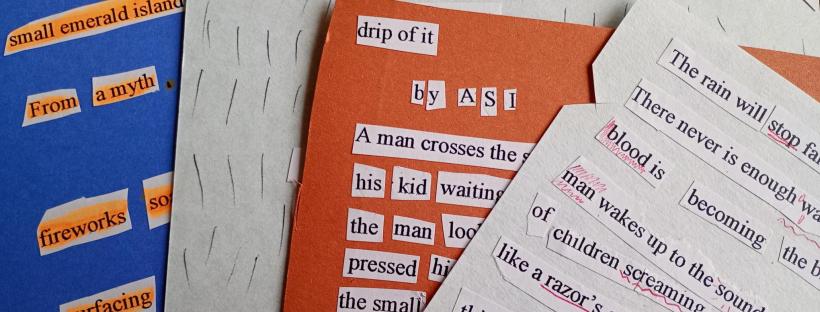
Like many of the best lessons, this one was easy to set up, and involved very little input from me during the lesson itself. All I did was to copy and paste four of the poems we’d studied, without their line breaks, into a Word document, leaving 1.5 spacing between the lines. I printed one sheet for each student in the class. And then I gathered all the scrap paper and cardboard I could find: the lids of old boxes lying around in the English office; the sheets of cardboard that often come in packs of A4 lined paper; flaps of old document folders that had been used many times; scraps of sugar paper; offcuts of coloured card.I brought all of this to the lesson, together with as many glue sticks and pairs of scissors as I could find. The lesson wasn’t entirely Powerpoint-free: I had one slide with an example of a cut-out poem on, just to give students an idea of what sort of thing they would be creating.

That was it. For a whole hour, on a Wednesday afternoon, my students were busily, happily and, best of all, creatively engaged in selecting, snipping, placing, rearranging, hunting, editing, adapting, illustrating, explaining as they created their own cut-out poems, using words from the poems we had been studying in our previous lessons. It was one of those lessons when, for much of the time, I really needn’t have been in the room at all. That freed me up to circulate and chat to students as they worked, hearing about the creative challenges they were encountering and how they were solving them. For example, what to do if you really needed a particular word and it wasn’t there? One student painstakingly snipped out every letter to spell the word he needed. Another did the same, and then realised that this meant she could be playful about the spacing between the letters, deliberately stretching the word out. She was able to articulate with great confidence why she had decided to do this and what impact she intended it to have on the reader.

At a time when there is so much concern about the amount of time young people are spending online, it was so heartening to see how satisfying these Year 8 students found the physicality of cutting, arranging and sticking, and how proud they were of what they produced.

In a lesson like this it’s amazing to see how everyone starts with exactly the same text – the words from four of the poems that we’d studied – but by the end of the lesson no two poems are alike. Cut-out poetry is an approach that supports those who lack confidence in writing: no one need worry about staring at a blank page, because the starting-point is always a page full of words. But it allows for huge flexibility in response. To return to that quotation from Emma Turner’s blog, it’s an approach that is ‘alive, it is interrogative, it is dynamic; it is fizzing with variables and influences’.

I welcome the sharing of approaches that celebrate what happens in classrooms when students are given the space, resources and inspiration to be active creators, rather than passive recipients.

Visit to the Botanic Garden

One of the highlights of the PGCE year is our visit to the Botanic Garden in Cambridge where, after a picnic lunch, the trainees explore the garden and devise creative writing tasks for each other, to be done at specific locations in the garden. We put all the ideas into a hat and each person pulls out someone else’s task and goes off to write. The afternoon finishes with the sharing of what we’ve written.

I’ve been taking trainees on this visit for seventeen years now, and the tasks are always different – and ingenious. Trainees might invite each other to note the names of two different species of rose and write a dialogue between them; they might be tasked with writing a folk tale about who lives inside the bricked-up tree; they might dare each other to become adventurers in the tropical hothouse, writing short stories about encounters with deadly plants.

It’s always great fun, and a wonderful way of drawing on all that they have learnt over their PGCE year – both as English teachers and as writers.

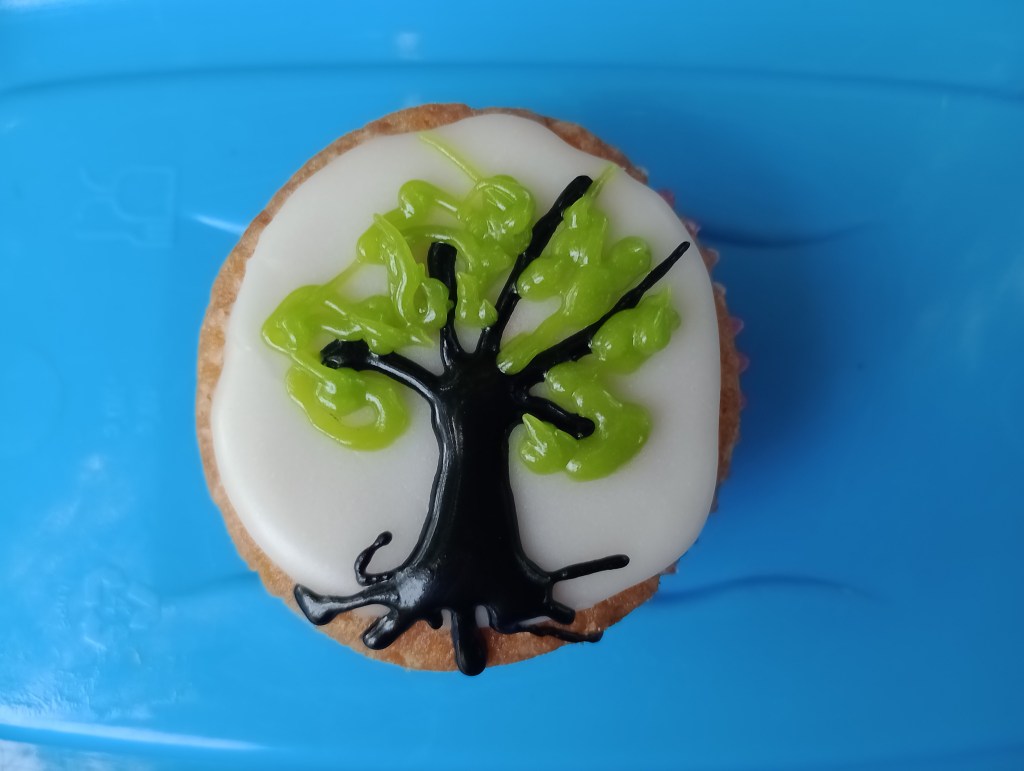
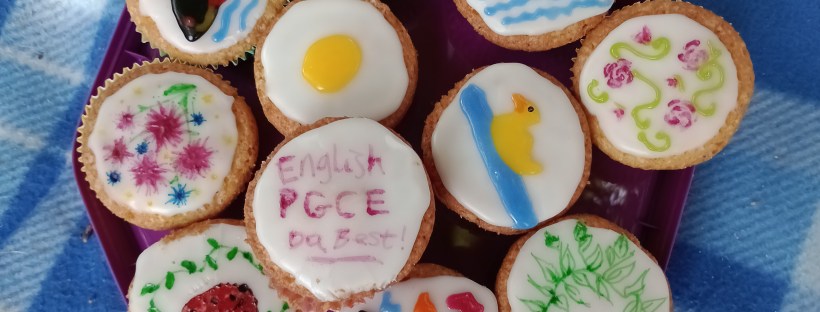
There’s also an invitation to respond creatively to the garden by decorating fairy cakes with writing icing, which we then share at the end of the day.

Playing netball in a lampshade

There was a moment in a Year 7 lesson in the first week of September when the surrealism of what I was doing convinced me I was in a dream. I was introducing myself to a new class in the middle of my first full teaching day after the lockdown. My head was hot inside my plastic visor, I was having to project my voice more than usual in order to be heard from behind it, and I’d gone for three hours without a sandwich or a cup of tea . A small area around the teacher’s desk had been cordoned off with black and yellow tape and I was doing my best to stay inside it for the whole lesson. I honestly felt as if I was playing netball whilst wearing a lampshade on my head and trying to teach a class at the same time.

After over two decades in teaching I’ve experienced many challenges, but nothing remotely like the experience of returning to school this term and teaching during the Covid-19 pandemic.

Mostly, it’s great to be back. After so many months away from the physical classroom I’ve fully appreciated more than ever before both why I like face-to-face teaching so much, and what can be done in the classroom that can’t satisfactorily be replicated online. During this second lockdown, it feels like a privilege both to have a job and to be able to leave the house to interact with real people.

But it’s so tough! Not in the dramatic way that many of us might have feared after having little contact with groups of people for so long, and then suddenly having to work in fairly cramped spaces with large groups of people. I won’t have been the only one worrying in August about how quickly and widely the virus might spread in our classrooms.

The reality is that so far, in my school, there have not been the multiple outbreaks that so many staff, students and parents feared. I write this fully aware that so many other schools have not been so lucky, and that those schools that have had to deal with a large number of cases amongst students and staff have had huge additional challenges to cope with. What there is for all of us, though, is substantial change to almost every aspect of school life.

I now teach each class in a separate room, spread out across the school so that different year groups don’t mix. This means teaching in science labs and music rooms, going to parts of the school I don’t normally see. More than anything, it means feats of both logistics and strength in order to ensure that each room I’m teaching in on any day has all the texts and equipment I need. Sometimes I make Antarctic expedition-style deposits of everything I need in each room very early in the morning; more often I end up carrying huge piles of things, Double or Drop-style, from one room to another throughout the day.

Once the school day starts, the pace is relentless. Teachers are, of course, used to this. But now that break and lunch times are staggered for different year groups, it’s possible to hit a run of lessons where you just miss every break time, going for as many as three or four hours at a time literally without even one minute’s break. Simply taking on board enough food and drink is a challenge, and I feel as if I’ve started eating like a participant in an ultra-marathon, cramming peanut butter sandwiches into my mouth en route from one room to the next.

At the same time, during periods when there has been confusion and non-compliance in society at large, I’ve found it strangely comforting to work in an environment where everyone knows what the Covid-19 rules are and, by and large, follows them. Watching students sanitise their hands as they enter and leave classrooms as a matter of course, and putting their masks on and off as appropriate, largely without any fuss, is hugely impressive. As difficult as all of the new routines are, they are clearly working to suppress transmission of the virus, and that’s very reassuring.

But on top of the logistics and physical demands, one of the biggest frustrations is that we can’t draw on our full range of teaching strategies. We can’t easily organise students into small groups for discussions as they must stay in their seats facing the front of the room. Teachers have to remain in our netball-style zones as much as possible, which makes it hard to have the quiet interactions with individual students that are at the heart of both subject teaching and behaviour management. All teachers in my department now have to be teaching the same things at the same time with each year group in case we suddenly have to move to online teaching with a whole cohort. This reduces the scope for us to use our own creativity and go off-piste, and it also means an awful lot of liaising with each other when classes are shared between two teachers. I long for the return to my own classroom, with its carpet and shelves of reading books for loaning out.

Hopefully, that return might now be possible within this academic year. The camaraderie amongst staff, and between teachers and their students, has been a very precious thing during a period in which many have felt isolated. But I long to take off my visor and wander to the back of my own classroom again.

Lockdown teaching

The question of How I’m teaching seems much more pertinent than What I’m teaching right now. With 23 years’ experience under my belt, it’s a long time since I’ve had to learn so much so quickly in order to do my job.

Parts of the media and government would have everyone believe that the only real learning taking place during the lockdown is happening via ‘live lessons’, and that independent schools are leading the way with this, leaving state school students far behind.

The reality, of course, is far more complex. Live lessons – lessons taught via Zoom/Google Meet etc, in which the teacher and students interact in real time – do play a part in my repertoire of online teaching strategies, and I’ve learned a great deal about how to conduct them successfully over the last few weeks. I’ve been team-teaching a sequence of lessons on First World War poetry with a colleague. We send the link to the lesson out to the whole of Year 9, and typically about 70 students ‘attend’, with the lesson also being recorded and sent round later so that others can watch it if they were unable to attend live.

There’s so much that feels odd about doing this. For starters, we’re each in our own homes, so we have to think carefully about what can be seen behind us. Students’ cameras and microphones are switched off, so all we can see is their names on the screen, which can make it feel a bit like teaching into a void. Teachers check instinctively all the time to see how well students are understanding and engaging with what they’re saying. How do you do this when you can’t see or hear your students? But we make extensive use of the ‘Chat’ function in order to keep the lessons as interactive as possible, and that has proved really useful. It’s lovely to ask a question and for responses to stream in on the chat. One of us is responsible for reading them out, whilst the other responds to the comments. It’s interesting to see who contributes in this format, and that it’s not always the same students who would be first to put their hands up in class. Students have also developed the confidence to let us know through the chat if they’ve not understood something, or if they need to ask a question about the task they’re doing. When we’re in full flow engaging with students’ comments and questions in the chat, it begins to feel like ‘real teaching’ – or at least the closest I’ve got to it over the last few months.

How helpful it is, too, to have both a recording of the lesson and a record of the chat to send round afterwards. Normally, there’s no written record of a class discussion, and no opportunity to play the lesson back afterwards, so these are both bonuses of online live teaching.

There are, however, really good reasons why most state schools are not offering as many live lessons as independent ones. At the start of the lockdown, a significant number of our students didn’t have devices at home on which they could have engaged with a live lesson, and/or internet access with which to connect. Even now, the government’s promised computers have not arrived at our school. A concerted whole-school effort of fundraising and logistics has now helped to ensure that the vast majority of our students are equipped with what they need to engage with online learning, but it’s taken a huge amount of work, and there are still some students who need work posted or delivered to them on paper.

And also, I challenge the assumption that live lessons are necessarily always better than the other sorts of learning we deliver remotely. Sure, the live interaction between teachers and students is hugely valuable. But we have other tools in our repertoire, and the most important thing of all, I think, is to give students a varied diet. This means sometimes setting work that doesn’t require a screen at all; giving students time and space to be creative through extended writing and drawing projects; providing powerpoints with audio commentaries that they can move through at their own pace; offering a choice of tasks. Above all, it means giving students regular feedback on what they’re doing so that they know that we still care about them, we value what they do, and we want to help them to make progress.

Overall, I’m probably just as busy as I would be at school. It’s just that my time is spent in very different ways: a lot more time at my desk responding to emails from students, as well as leaving comments on their work online; lesson preparation time that also now involves intensive learning about all the various settings on Zoom that we need to have in place for safeguarding; liaison with parents and carers about all the many disparate reasons why their children might be struggling; and lots and lots of planning and thinking about just how things might be when we finally return to school in September.

Pandemic journals

I’ve been keeping a diary since I was 12, when, after a few false starts, it became a daily routine. By the time I was in my late teens I knew that this was a habit I’d keep for life; now, I find it unimaginable to think how I would function without it.

I’m not obsessive about it: I don’t take my diary on holiday, and I might miss the occasional entry after a late night.

For some people, it’s the act of diary-writing that is so precious – that feeling of confiding in someone, treating the diary almost like an intimate friend. For me, the really valuable thing is being able to read my diaries back. This helps me to spot patterns – ‘Oh, I always feel like that at the end of January!’ – which can bring a sense of relief. It’s also very handy if you’re involved in an argument with someone about the details of when or how something happened! More than anything, I just love being able to go to my diaries and look up what I was doing, thinking and feeling on any particular day.

I gain such satisfaction from keeping a diary that I’m delighted when I can spark that interest in others. 12 years old seems to be a fairly typical age for starting a diary, so I’ve often tried to chat to the children in my life about it at around that age, in the hope that they too might be bitten by the diary-writing bug.

But it’s not something I’ve ever particularly explored with my students.

And then the pandemic arrived. And all of a sudden we had to set two weeks’ worth of work for our classes to do independently at home before we (and they) could regroup for the Easter holiday. In thinking what to set for my Year 9 classes I was aware of two things: firstly, that an awful lot of the work they were being set was likely to need to be completed online; and secondly, that they were living through an epoch-defining historical event that they would be talking about for the rest of their lives.

For both of these reasons, setting my students the task of keeping a personal journal during this period felt like a really good project. Although obviously I had to set the work through my school’s remote platform – the students would need to go online to find out what to do – the first task I set was to find or buy a notebook – ideally one which reflected their personality or that seemed to them like a lovely or special object to write in. It felt important for these journals to be actual artefacts, rather than electronic documents. Assuming that most of my students would not be regular diary-writers, I explained to them that I wanted them to develop the habit of writing in their journals about their daily lives at least twice or three times a week if possible (and more often if they liked), but I also set a few short tasks each week for them to do. These were tasks that I hoped would help them to engage with the physical and natural world around them, as well as encouraging them to see the current situation from different perspectives.

Diaries are best-written, I think, when they are written without fear of anyone else reading them, and when they reflect the specific, everyday detail of what’s going on at the time – however trivial or dull that might seem.

So I’ve told my students that I won’t be ‘marking’ their diaries – that they are entirely personal to them. However, I have encouraged them to photograph snippets from them that they are happy to share, and to send them to me. It’s been fascinating to read what they have written so far, and I am struck once again by the resilience of so many young people in the face of quite extraordinary circumstances and restrictions.

I hope both that these journals will become precious artefacts for my students to look back on when they are much older, and also that for some of them, this kindles a regular diary-writing habit that will last them a lifetime.

Here are some of the tasks I’ve set my students to do in their journals:

Write today’s date at the top of the first page. Set a timer for 15-20 minutes and just free-write without thinking too hard about it. Write about this weird last week. Write about the changes in your life, your hopes and fears, what you’ve noticed most in the world around you, in terms of what’s stayed the same and what’s different. After your timer has gone, read back through what you wrote. Think if there’s anything else that a future you (in ten or twenty years’ time) might find interesting about what’s going on right now. Spend another 20 minutes adding anything else you want to.

Find something to stick in your journal. This might be a poem or an inspirational quotation that you find. It might be a feather or a petal that you pick up outside. It might be a ticket to something that you can no longer go to. You decide. It’s up to you if you want to add a note next to this or not.

Go outside – if you can do so safely. Otherwise, look out of a window. Write a journal entry from the perspective of a living creature you can see, for example a butterfuly, ant or robin. What does the garden or street look like from this creature’s point of view?

Find a poem either online or in a book which can provide you with inspiration at this time. Copy it by hand or print it out and stick it into your journal. Illustrate and/or annotate it with your response to it.

Living words

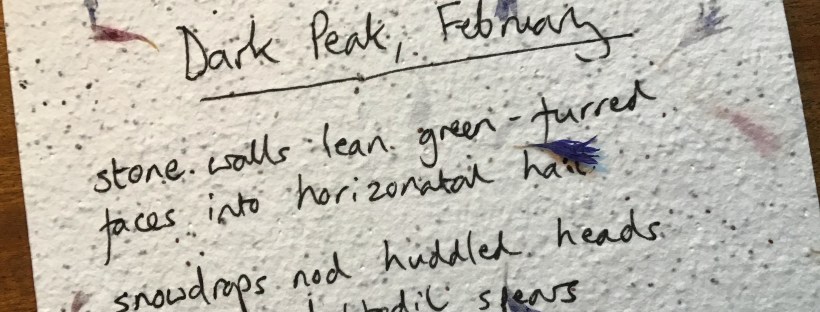
I’m really grateful to my friend Sean Dooley for sending me a poem written on seeded paper all the way from Shanghai and setting my teachers’ writing group the challenge of writing our own poems on plantable paper.

We’ll meet later this week to share our poems, with a view to planting them afterwards and seeing what comes up in the spring. Much as it feels a bit sacrilegious to plan to bury something in the earth that we’ve each created so recently, I also love the idea of literally growing something out of a poem. I hope to be able to post some pictures later on of what grows from our words.

The poem I’ve written, ‘Dark Peak, February’, was inspired by a visit to The Peak District during half term, during which I led a creative writing workshop for Her on a Hill. We were able to get outside despite Storm Dennis, although we were glad to retreat to the church hall in the afternoon to develop our writing further over tea and cake in the warm and dry.

Graphic novels inspired by ‘The Arrival’

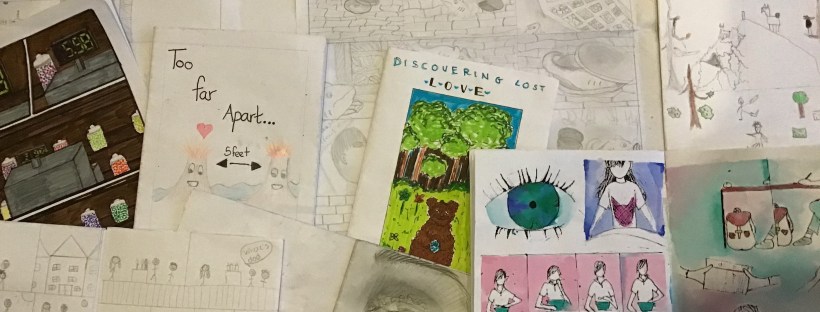
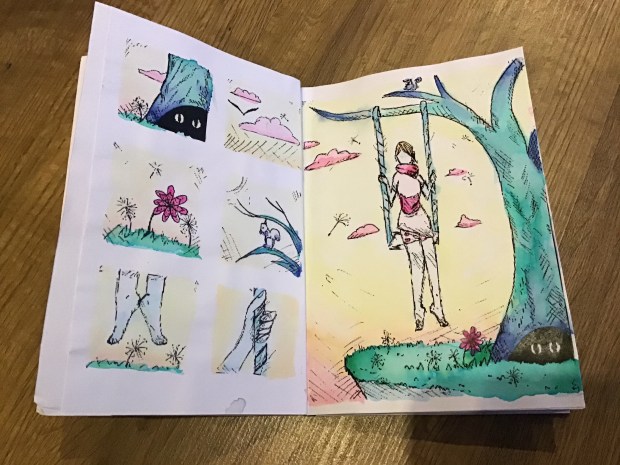
What a lovely pile of marking! Following our study of Shaun Tan’s The Arrival, half of my Year 9 class chose to write stories in which they experimented in words with some of the visual techniques that Tan uses (such as zooming-in), whilst the other half created their own graphic novels. I’m blown away by some of these graphic novels. Here are the opening pages of my favourite:

‘The Arrival’ by Shaun Tan

I’m teaching one of my favourite texts with my Year 9 class at the moment – The Arrival by Shaun Tan. It might seem strange to be studying an entirely wordless graphic novel in an English classroom, but I find that it lends itself to a sophisticated level of very close ‘reading’ of each image, and I love the collaborative nature of this as students point things out to each other and explore what they think is going on, with so much left to the reader’s imagination. There’s a wonderful essay on Shaun Tan’s website called Picturebooks: Who are they for? which outlines this process really well. We’re also using The Arrival as a stimulus for creative writing too, learning to apply some of the visual techniques Tan uses, such as zooming out and showing not telling, to our own writing. I’m really looking forward to seeing the graphic novels and stories my students will have produced by the end of the unit.

Year 7 poetry anthologies

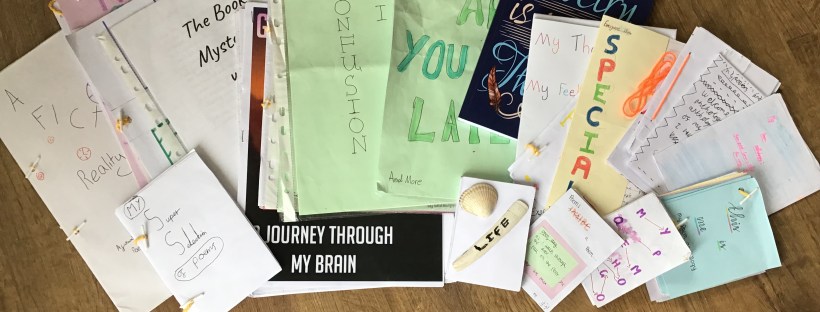
Our Year 7 Poetry scheme of work covers poems from a range of periods and in a diverse range of forms and styles. Throughout the unit, students read and explore poems by professional poets and are then invited to respond with their own work, learning about aspects of craft such as rhythm, line breaks and imagery as they go. My favourite part comes at the end, when students create their own anthologies, including a mixture of their own poems and those by other poets that they’ve read and enjoyed. It’s lovely to see what happens when students are given freedom and ownership. This year’s anthologies were particularly creative, including one poem, Reflection, which had entirely been written backwards. On the opposite page, the student had stuck a mirror so that the poem could be read forwards. Other students had experimented with poems which involved key words or lines being written on fold-out bits of paper. There’s something wonderfully tactile about these little books which is particularly refreshing in an age when so much reading is done on-screen. I also love the titles of these anthologies, A Journey Through My Brain being a particular favourite.