I have a few events coming up over the next few weeks, if anyone is interested in attending a poetry reading or a writing workshop.
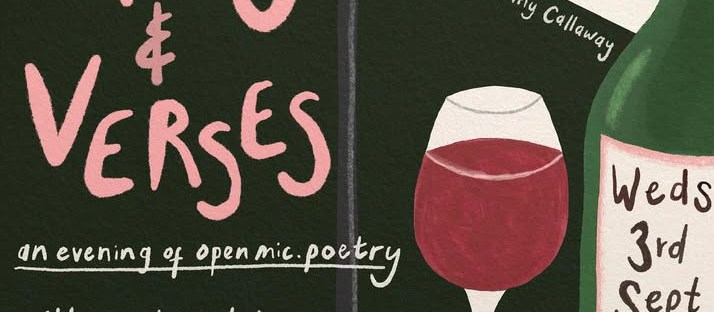
First of all, I’m reading from The Opposite of Swedish Death Cleaning at the new poetry night hosted by Bethany Callaway at Chater’s in Saffron Walden on Wednesday 3rd September. Beth only launched this monthly event in July, but the first two months were sold out, so grab a ticket quickly if you’re interested in coming along in September. I really admire Beth’s tenacity and flair for getting this going so successfully in such a short space of time. There are open mic slots available, and I’ll be doing a 20 minute set before the interval.
On Monday 22nd September from 5pm I’ll be running an online poetry writing workshop on Zoom for the Mslexia Salon called All Over the Place, in which we’ll be exploring a range of ways to generate new poems from fresh encounters with familiar and unfamiliar places.
I’ll be reading at Cambridge’s regular poetry night in the Town and Gown, CB1 Poetry, on Sunday 5th October from 6.30pm.
And finally, I’m headlining the lovely Fen Speak at Centre E Community Hub in Ely on Thursday 16th October from 7.30pm, with two poetry sets alongside a range of wonderful open-miccers.
Do get in touch via my contact form if you’d be interested in booking me for a poetry reading or writing workshop from November onwards.
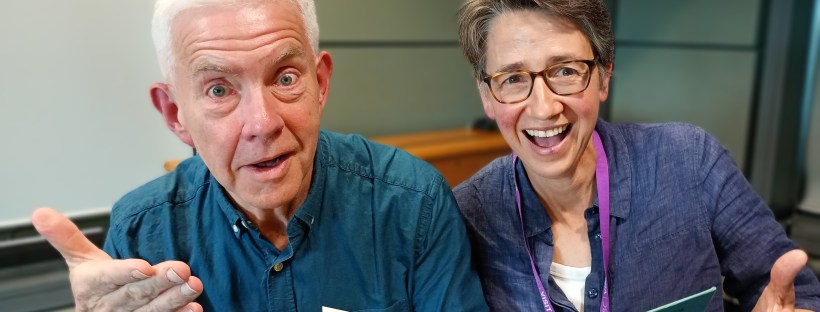
It was a dream come true to have the opportunity to read and talk about three poems from The Opposite of Swedish Death Cleaningon BBC Radio 4’s The Verb, hosted by Ian McMillan, and alongside guests Fiona Benson, Boo Hewerdine and Yvonne Lyon.
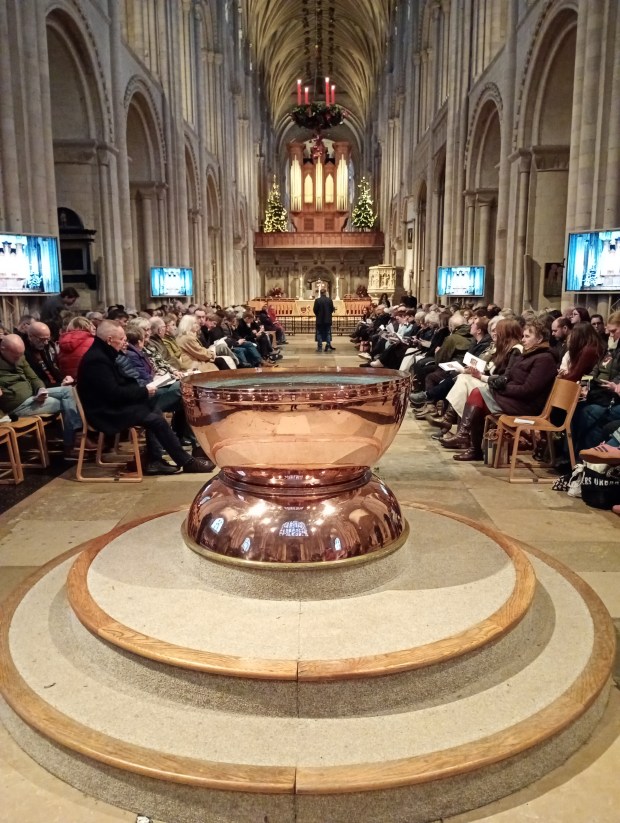
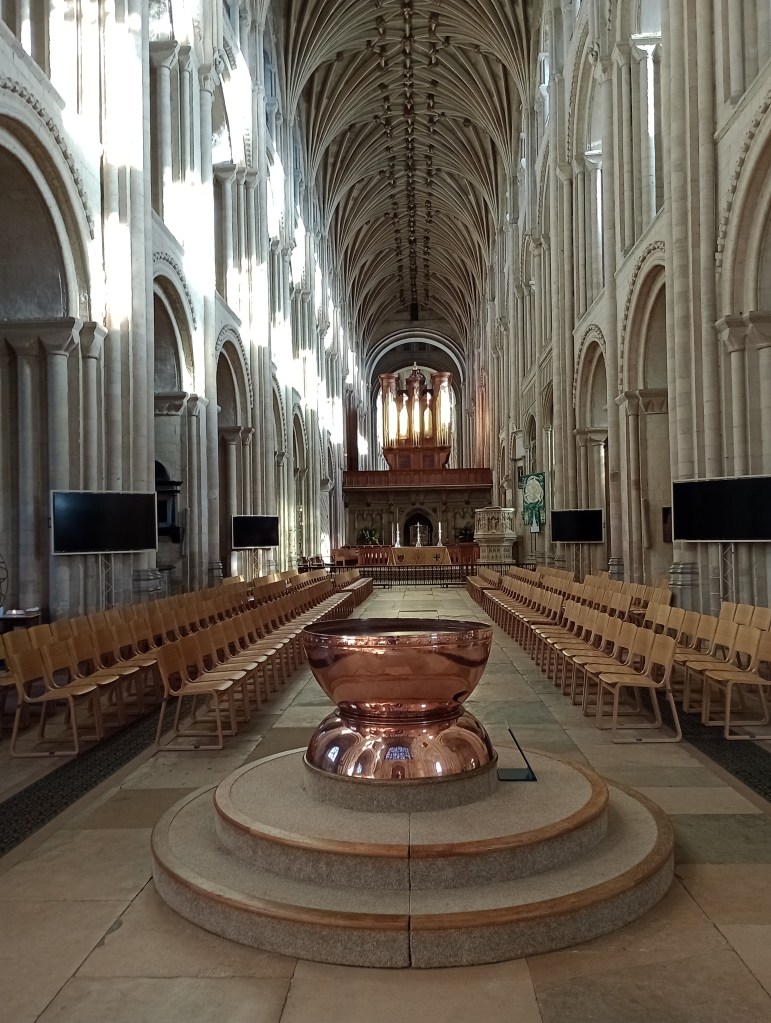
Although the focus of my segment was on writing about a parent with dementia – something that felt particularly poignant given that the programme was aired on Fathers’ Day – I was really glad that Ian had selected Muscle Memory for me to read and discuss, as it’s a reminder of the moments of joy that can still be found even amidst so much loss. Here’s a photo of the beautiful copper font in Norwich Cathedral ‘that stretched our faces like toffee’ – an allusion to the fact that it was donated when the Rowntree’s chocolate factory closed down, having previously been used to melt toffee.
I love Fiona Benson’s collection Midden Witch, so it was brilliant to hear her talking about the stories behind some of these poems, like The Witch of Easington and Jenny Greenteeth. Some of my favourite poems in this collection are those inspired by birds and animals, and it’s fascinating to see how placing them in a section entitled ‘Familiars’ curiously shifts the reader’s perspective on creatures such as bowerbirds and snails.
Boo Hewerdine and Yvonne Lyon’s songs about things that fall out of books tied the whole show together, and it was spine-tingling to hear their music up close in the studio. I was so touched that Boo set a line from Inside the House of Delirium to music: ‘The curtains sleep until midday’.
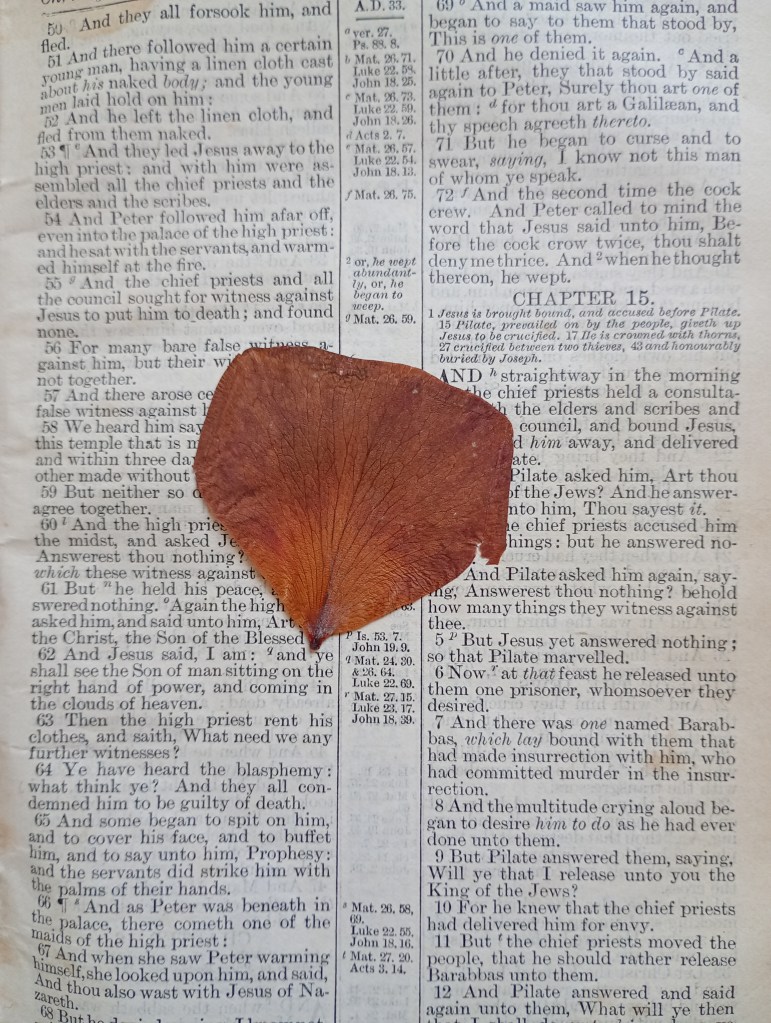
If we’d had more time, I would have shared this poppy petal that fell out of my great grandmother’s Bible, which she used as a flower press. It’s incredible to think that it must have been flowering in a Cornish hedgerow in the 1880s.
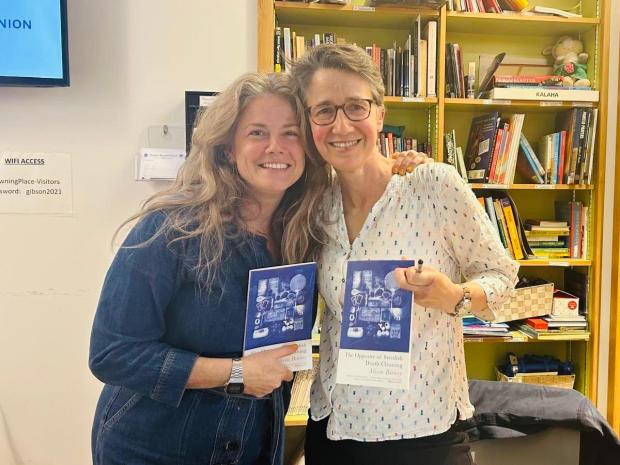
It was lovely to celebrate the publication of ‘The Opposite of Swedish Death Cleaning’ on Friday 16th May at Downing Place United Reformed Church. There were people there from various different parts of my life: teaching friends, rowing friends, church members, friends I was at school with, members of the U3A contemporary poetry group I’ve led sessions with, and walking friends, as well as members of my family.
It was a particular honour to have Kate Winter there, the artist who designed the stunning cover for both this poetry collection and my pamphlet, ‘Other Women’s Kitchens’.
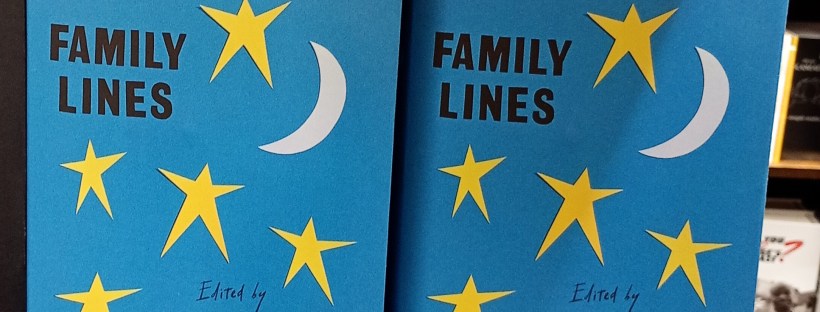
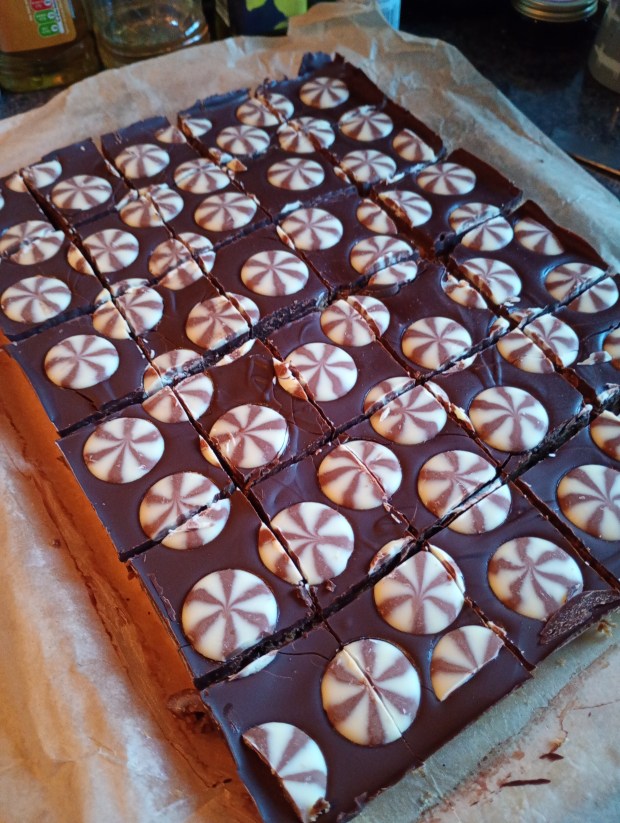
The launch was accompanied by a huge batch of chocolate fridge cake, made by my partner Emily to my grandmother’s recipe, which is handwritten in the recipe book that appears in the top left hand corner of the cover.
I have a series of other launch events lined up over the next few months, and would be delighted to see people there. Here are the details:
I’m also very open to invitations to read at other events, so do drop me a line via the ‘Contact’ section on this website if you would like to make a booking.
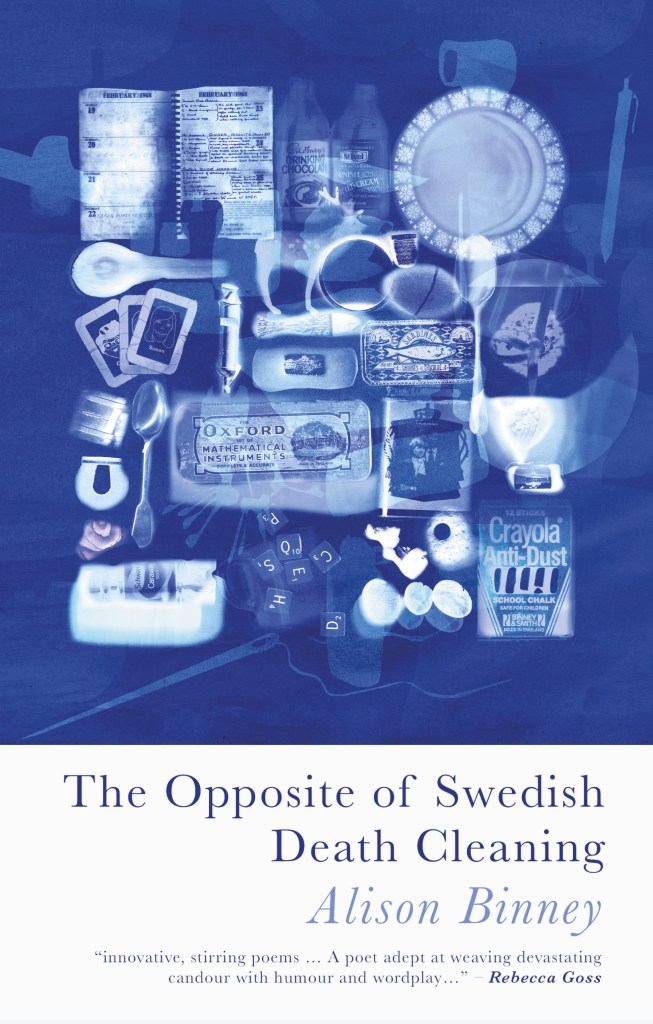
I’m delighted to be able to reveal the cover art, which was created by my friend Kate Winter, author and illustrator of The Fossil Hunter.
Kate is brilliant to work with: I can share with her a general sense of what I’m looking for, and then she goes on to create something that somehow captures what I had been trying to describe, but in a way that I could never have imagined.
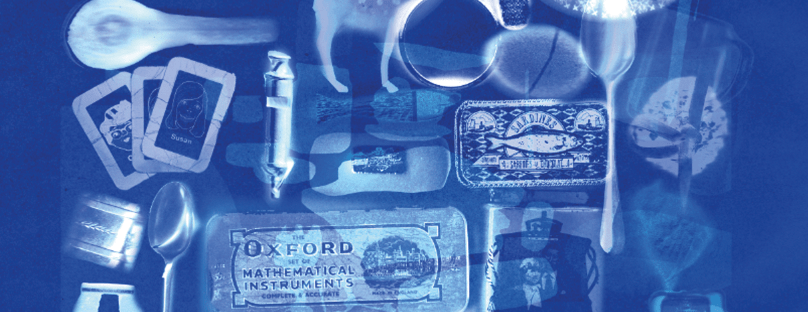
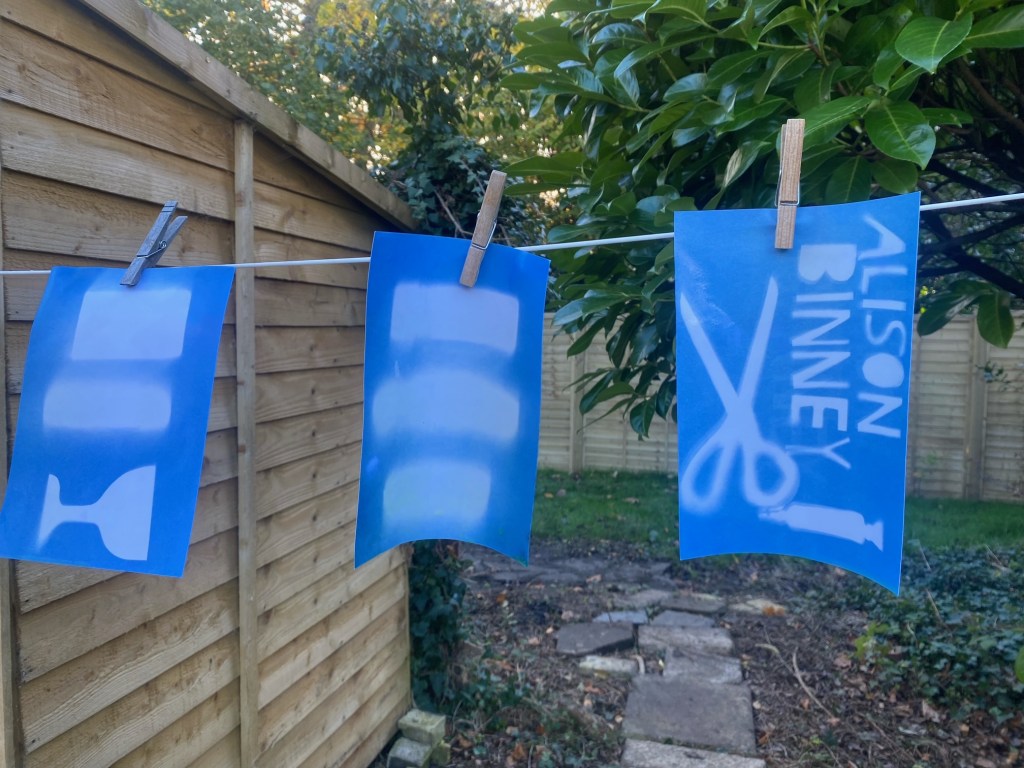
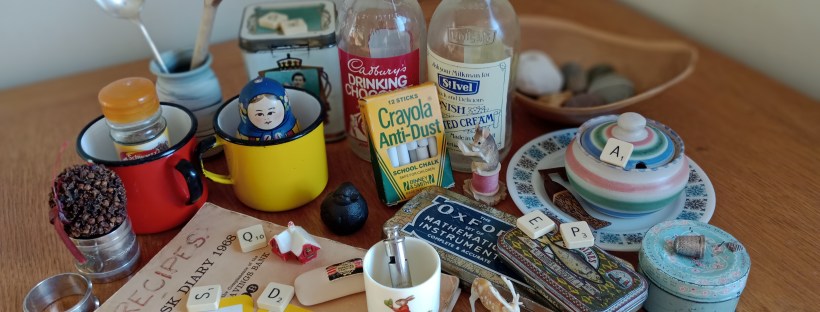
In this case, Kate picked up on the idea of the importance of the objects I had retrieved from my parents’ house, and the resonance they carry. This led her to experiment with cyanotype, which is an early form of photography using sunlight to create impressions of objects on paper. I loved the vivid blue of Kate’s early drafts, and the idea of objects leaving a physical impression in this way fitted the mood of the book perfectly.
Kate then borrowed a box of treasured objects from my parents’ house to create the final image, which deploys a combination of cyanotype, hand drawn and digital art images, juxtaposed in a collage.
Alongside providing a beautiful cover for the collection, I’m so pleased that these precious family objects have been captured by Kate in this way. Amongst them you can spot the reindeer from our Christmas cake, both my parents’ chalk tins, my grandmother’s handwritten recipe book, two milk bottles from my 1980s collection, some Guess Who cards, and an iconic Charles and Diana tea caddy.
When you read the poems in the collection, you’ll be able to spot some of these objects featuring in particular poems.
In July 2022, a few months after my Dad had been admitted to a care home, my brother and I embarked on the process of sorting and clearing his house. That first day, I opened the garage door to find a huge mound of boxes, paint pots, rolls of carpet and garden furniture.
Over a tea break, as pure procrastination, I searched online for ‘advice for clearing a family home’, and that’s where I first cam across the concept of ‘Swedish death cleaning’.
Margareta Magnusson’s ‘The Gentle Art of Swedish Death Cleaning’ had been an international bestseller just five years previously, but it was only too clear that the concept of döstädning – of de-cluttering one’s own life in late middle age – had completely passed my Dad by.
During those first hours of endlessly ripping and folding every cardboard box that had entered my Dad’s house over the previous twenty years, I fantasised about a woman in Stockholm entering her father’s home to sort his affairs, only to find an almost empty house, full of light and the scent of lemons.
How I envied her! A poem about her began to form in my head.
But it took many months to write, and during that time, as I sorted and cleared my Dad’s house, room by room, my feelings about this imaginary Swedish woman, whose father had scrupulously death-cleaned, completely changed.
And so the poem became completely different from how it had started. I realised that what I was doing was the opposite of Swedish death cleaning: I’m not Swedish, I was the one doing the death-cleaning on behalf of my father, who didn’t even know it was happening, and the whole process felt very far from clean.
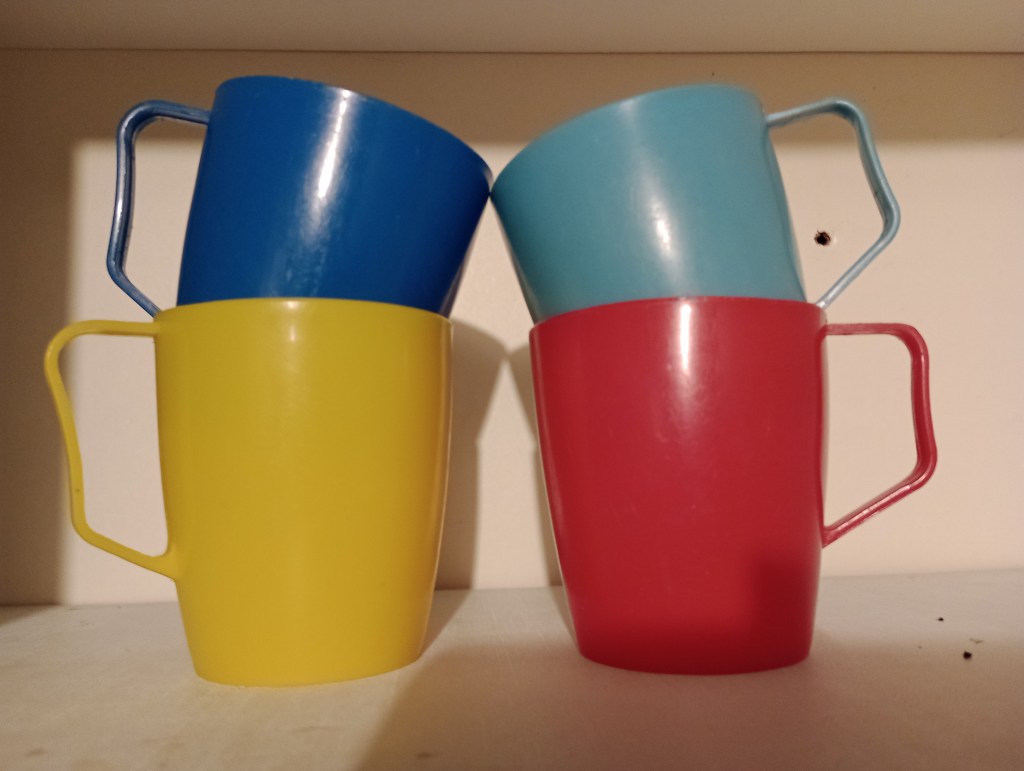
But I wouldn’t have had it any other way. It was difficult, physically and emotionally demanding work, but it was also deeply healing. I wouldn’t have missed those experiences of being reunited with childhood games, cassette recordings of family holidays, and 1970s picnicware for the world. And I felt closer to both my parents – one having died twenty years previously, the other in the depths of dementia – than I had for ages.
‘The Opposite of Swedish Death Cleaning’ became the title for my poetry collection, which is forthcoming from Seren Books in April 2025.
When I first tried out Other Women’s Kitchens as a title for my debut poetry pamphlet, I was surprised to find how many of the poems in it are set in kitchens, or makeshift kitchens. I continue to draw on kitchens for inspiration in my writing, particularly in some of the recent poems that have arisen from the experience of sorting and clearing my parents’ house.
Some of my favourite poems by other poets are set in or around kitchens. I think of Seamus Heaney’s sonnet about peeling potatoes with his mother, for example, Mary Jean Chan’s They Would Have All That, and Alison Brackenbury’s collection Aunt Margaret’s Pudding, inspired by her grandmother’s recipes.
For me, kitchens, more than anywhere else, are the spaces where important things happen. Eating is both a primal need, and something that can be sophisticated and elaborate, such as cooking for a date or a dinner party. Cooking and eating are ritualistic acts, both in the everyday repetitions of making cups of tea or bowls of porridge, and also in the less frequent but perhaps more highly-charged rituals of Christmas, Thanksgiving, Shabbat, Iftar. Food is nourishment, treat, discipline, spectacle, connection, tradition, symbol, sacrament. And kitchens are places where we gather to eat and to cook intergenerationally, with all of that passing-on, both implicit and explicit, that takes place when we do those things with others.
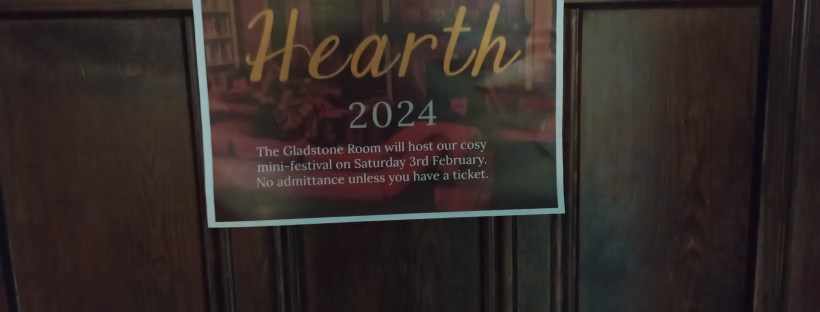
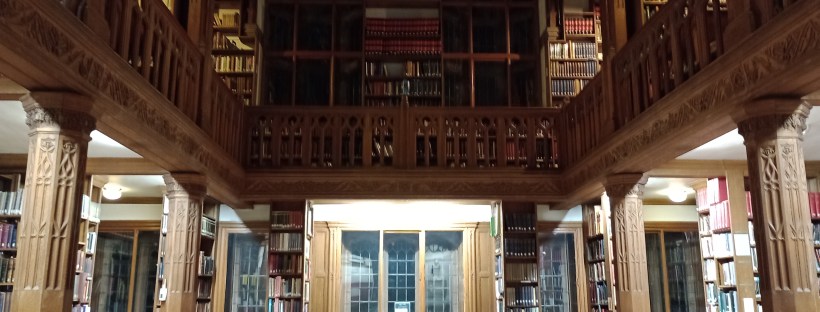
So it was strange to give a talk entitled ‘A Kitchen of One’s Own’ at Hearth 2024, while staying in the wonderfully congenial environment of Gladstone’s Library, where three delicious meals a day were cooked for me in the Food for Thought cafe. There, not only did I not need to cook – a sign saying ‘Strictly Staff Only’ kept me banned from the kitchen for three days.
As lovely as it is to be cooked for, it’s fascinating what that does to the rhythm of life. Days feel much longer when you don’t need to shop, plan meals, cook or wash up. But it also makes me feel somehow wrong-footed when that rhythm is suddenly removed.
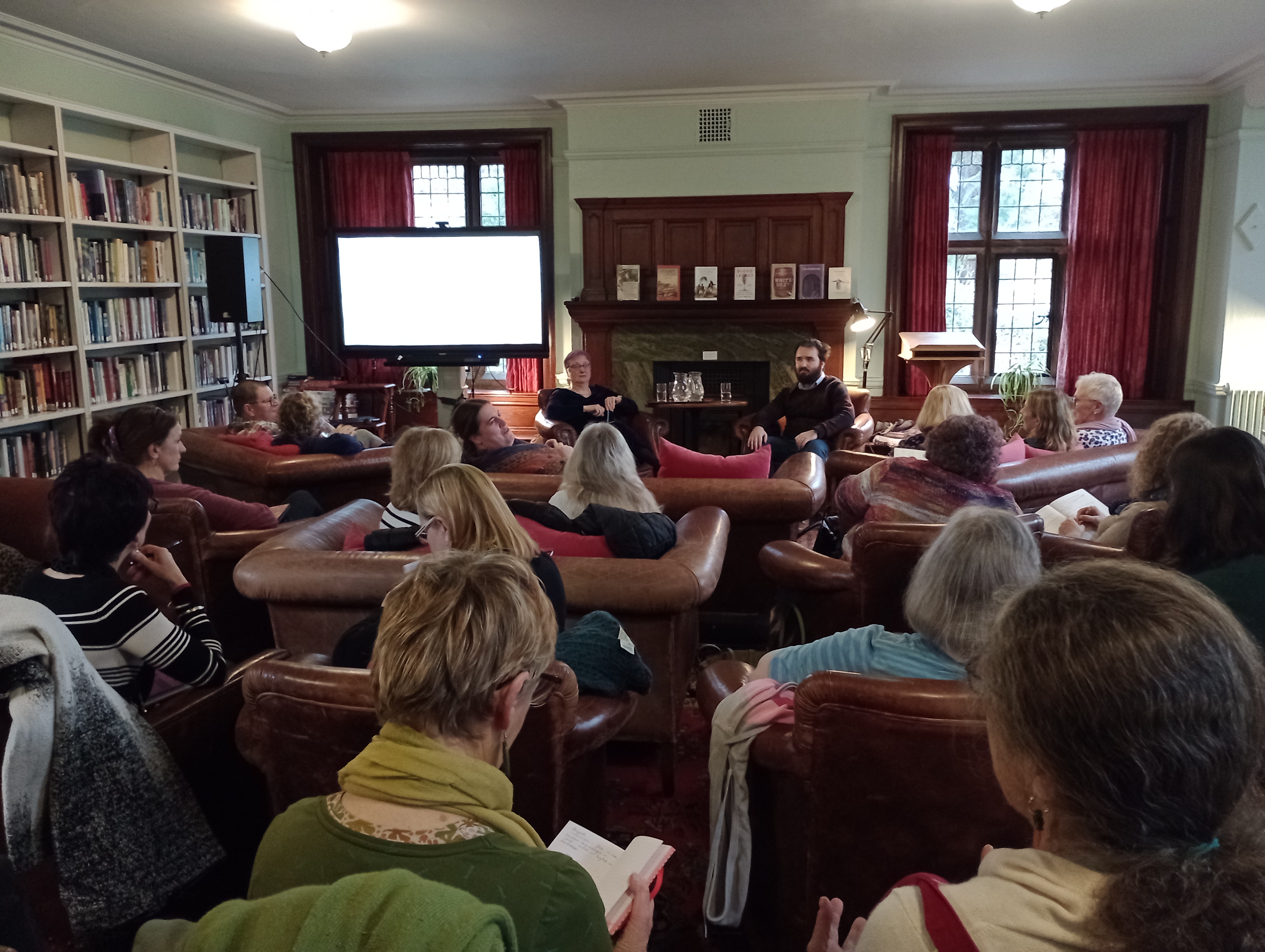
That observation proved a helpful starting-point for my talk at Hearth, the annual mini-festival at Gladstone’s Library, which was a lovely event to speak at, with the talks taking place in the intimate setting of a lounge filled with comfy leather sofas. After my talk, I thoroughly enjoyed listening to the other speakers – Eleanor Wasserberg, Frederick Bricknell and Louise Gray. Although on paper it was hard to anticipate how our four talks might work together, it was fascinating to see common themes emerging and developing throughout the day: the challenge of listening to undocumented voices; the sharing of family history; the dilemmas around sourcing and eating particular foods. The audience – warm, receptive, astute – played a huge part in helping those threads to emerge, and in enabling the conversations to continue over lunch and dinner.
I’m so grateful to the team at Gladstone’s Library for the privilege of speaking at Hearth, and for the wonderful hospitality, organisation and welcome. I will definitely be back, and I’m looking forward to it already.
It was a huge privilege to be invited to lead a workshop for the wonderful Mslexia Salon last month on assembling and submitting a poetry pamphlet. I have a lot to thank Mslexia for, as the first magazine to publish one of my poems, back in 2004, and then as the launch-pad for my debut pamphlet Other Women’s Kitchens, which was published by Seren Books in 2021 as a result of winning the Mslexia Poetry Pamphlet Competition.
The Mslexia Salon is brilliant value – just £12 a year for access to a huge range of online writing workshops and resources. And it was a joy to deliver a session for such a supportive, dedicated group of women, who sustained huge levels of enthusiasm right throughout the two-hour session on a rainy October evening.
Joining the Salon also provides access to recordings of sessions, which is really handy if you’re not able to attend them live. My session covered the following topics:
Am I working on a pamphlet?
How thematic should a pamphlet be, and how might a theme emerge?
How to sequence a poetry pamphlet
What’s in a name? How to choose an overall title, and a consideration of which titles draw the reader in when seen on a contents page
In praise of the poetry pamphlet
Submitting to pamphlet presses and competitions
It was lovely to work with women at various stages of the pamphlet-writing process, and I’m really looking forward to seeing some of these pamphlets out in the world in the near future.
Reviews from attendees:
“Wonderful! The most useful seminar I’ve ever attended.”
“This has been amazing – I’m at the point where I’ve submitted and been declined twice, know I need to revise but had no idea what to do. Now I have a plan!”
“Thank you for a brilliant session. Really useful and great that you managed to make it all relevant, whatever stage we are all at. Lots to think about and be excited about.”
“Thank you so much, so beautifully and generously given, the way you’ve delivered the information with the kind warm tone of your voice has given so much more than just the information – so encouraging to be held in a space like this where writing poems is valued. Thank you.“
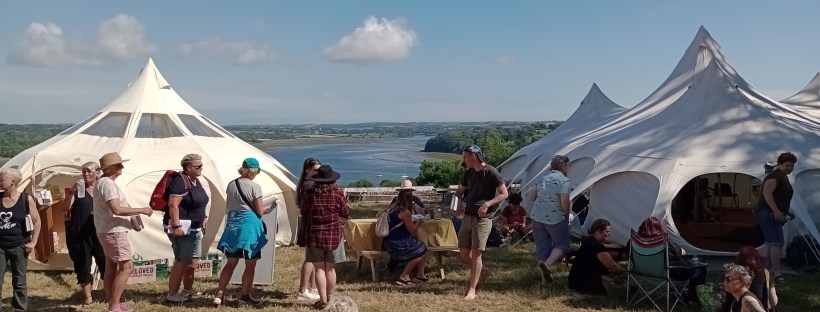
It was a lovely treat to be invited to read at the Out and Wild Festival earlier in June. In just its second year, Out and Wild is a wellness festival aimed at LGBTQ+ women which takes place in the beautiful coastal setting of Lawrenny, in south west Wales.
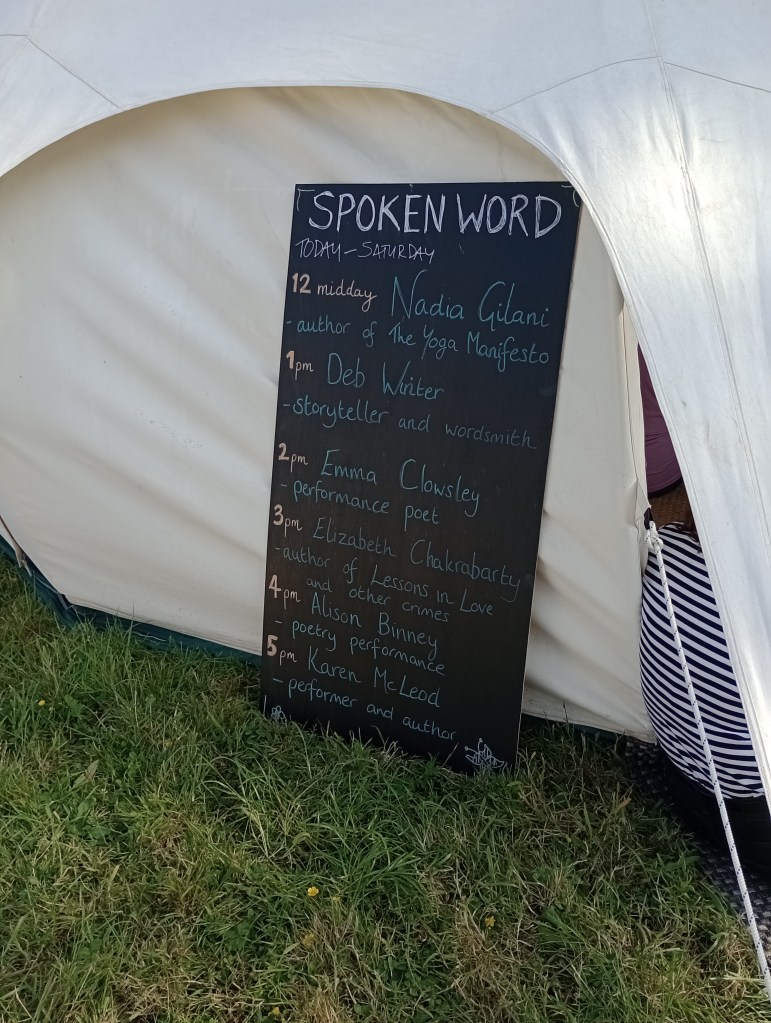
The Spoken Word tent was a cosy oasis of bean bags and benches, with a stunning view over the estuary through the back. I don’t think I’ll ever do a reading with a better view! The space created an intimate, friendly feeling for all the readers, and I particularly enjoyed the performance by storyteller Deb Winter earlier in the afternoon.
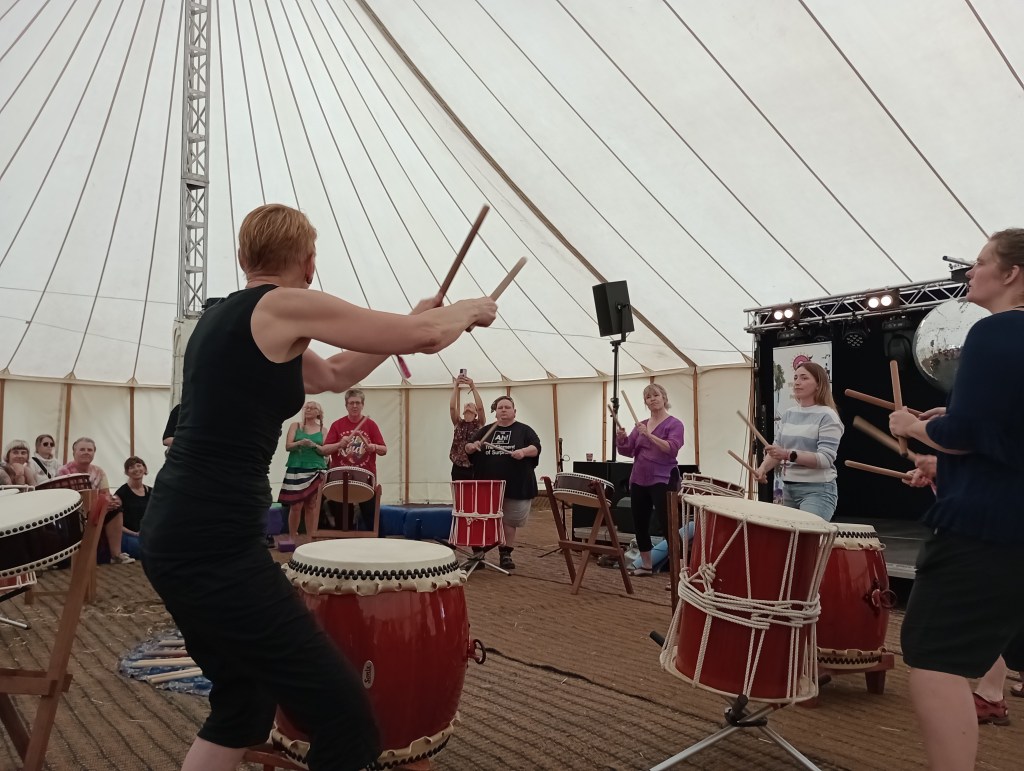
I made the most of the rest of the festival too, experiencing Taiko Drumming, Forest Bathing and a Silent Disco for the first time.
Given that the festival focused on LGBTQ+ women, it was a great space for reading some of the poems from Other Women’s Kitchens, and I really appreciated chatting to several women afterwards about how the poems resonated with their experiences. It was also good to try out some new poems on an audience for the first time.
With just 700 people there, the whole festival had a really friendly vibe, and it was good to keep bumping into the same people at different activities. I’m really looking forward to going back!
Last February, whilst on a walking holiday in Haworth with Her on a Hill, I discovered Wave of Nostalgia, a wonderful independent bookshop which specialises in books by and about strong women. I dropped off a copy of ‘Other Women’s Kitchens’ in the hope that the shop might be willing to stock it, and by the time I got home from the holiday I’d received an email asking for twelve signed copies, and proposing that I go back to do a reading.
Diane Park, the bookshop owner, has created an amazing performance space in the cellar underneath her shop, and it was a delight to be there in the first week of April, reading from ‘Other Women’s Kitchens’, plus some more recent poems, for a really engaged, receptive audience.
I’m honoured to have been chosen as the Selected Poet for Issue 85 of Magma, especially because the theme of this issue is ‘Poems for Schools’. Copies of this issue have been sent to all the GCSE exam boards in an effort to tempt them to widen the range of poems and poets included in future English Literature anthologies.
In my long experience of teaching GCSE classes, there’s no particular formula for poems that 14-16 year-olds will enjoy reading and exploring. Teaching English would be very dull if that were the case. I’m impatient with lazy assumptions, such as that 21st century teenagers have no appetite for poems about nature, for example, or that they only want to read about issues that directly reflect their lives. I’ve witnessed students’ passionate reactions against the protagonist in ‘Hawk Roosting’ – ‘I hate that bird. He thinks he’s all that, but he aint!’ – and equally engaged conversations about the attitudes towards women suggested by the speaker in ‘She Walks in Beauty’, and the extent to which they’re still evident today. Good teaching, of the sort outlined by Barbara Bleiman in her excellent article in this issue, is, of course, the crucial factor in supporting students in their exploration of poetry and whetting their enthusiasm.
However, the GCSE poetry anthologies are long overdue an overhaul, beginning with a challenge to Michael Gove’s fixation with Romantic poetry, as if that era somehow represented the pinnacle of poetry written in English, and it’s been downhill ever since. The poems in this edition of Magma represent a much broader and more invigorating range of poets, themes and poetic forms, and I’ve already found many that I’d love to teach.
Recordings of my six poems from Issue 85 can be found here. If you’re an English teacher and you try any of these poems in your classroom, I’d love to hear about what you do with them and how your students respond.